The Earth Element in Saju: Stability, Trust and the Middle Ground
Earth is the element of stability in Korean Saju: the ground between seasons, trust, routine and keeping things together. What lots of Earth or little Earth means, and how to bring Earth into your days.
Every friend group has one. The person who remembers everyone’s birthday, keeps the group chat from falling apart, and somehow becomes the one everyone calls in a crisis. They’re not always the loudest. They’re the ground everyone else stands on.
In Saju, that’s Earth (토, 土): the element in the middle, holding things together.
Quick answer: Earth (토) is the Saju element of stability: the turns between seasons, home, trust and keeping things together. Yang Earth is a mountain and Yin Earth is a garden field. Plenty of Earth tends to mean dependable and slower to change; little Earth tends to mean steady routines help.
What Earth means
| Theme | Stability, trust, mediation |
| Picture | A mountain; a garden field |
| Season | The turns between seasons |
| Traditional colors | Yellow, beige, ochre, brown |
| Direction | The center; your home base |
| Feeds | Metal (ore forms in the ground) |
| Is fed by | Fire (ash becomes soil) |
| Keeps in check | Water (a riverbank) |
| Is kept in check by | Wood (roots break up soil) |
Earth is the only element without its own season. Instead, it sits at each turn of the year: the end of winter, spring, summer and autumn. It’s the pause between chapters, where one season is stored and the next gets ready. That’s why Earth is linked with the center, with home, and with the person who keeps things steady.
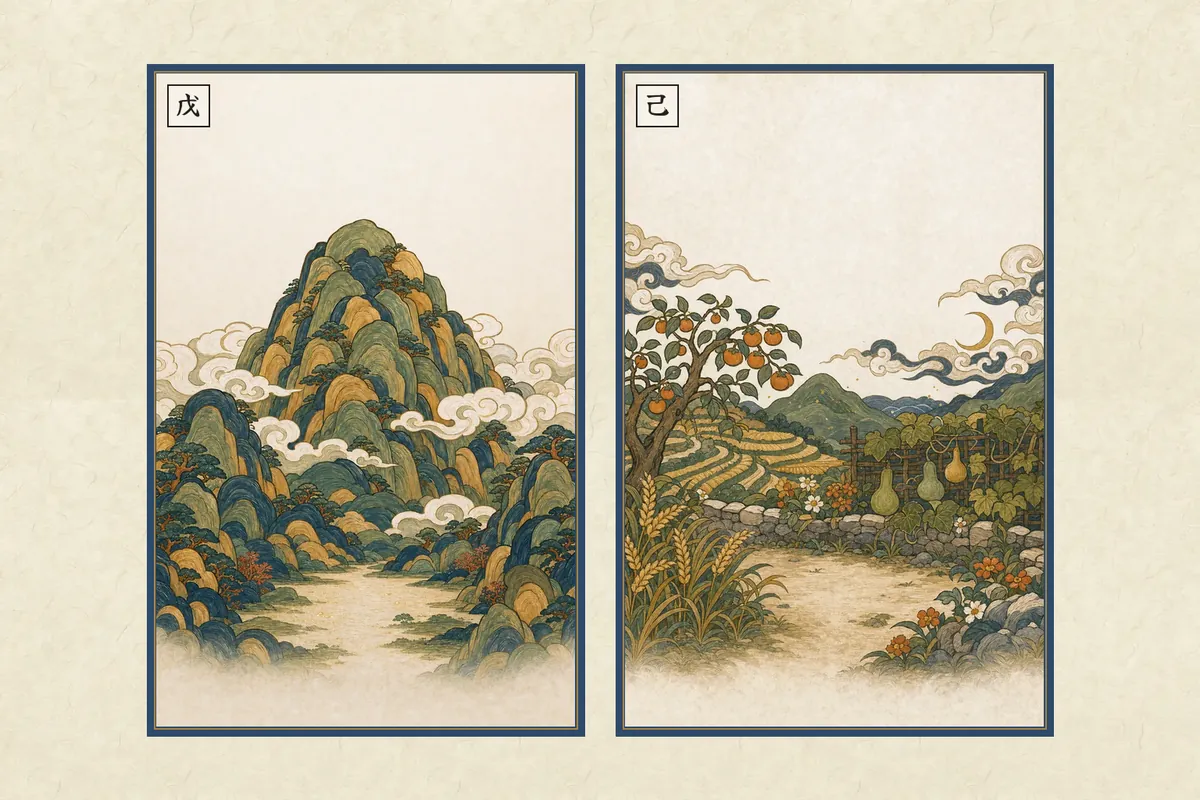
The mountain and the field
Earth appears as two Heavenly Stems:
- Yang Earth (戊, Mu): the mountain or dam. Solid, steady, hard to move. Responsibility and a calm center. Yang Earth Day Master →
- Yin Earth (己, Gi): the garden field. Soil that nurtures and organizes growth. Practical, careful, realistic. Yin Earth Day Master →
The mountain holds its ground. The field helps things grow on it.
Four of the twelve animals are Earth: Ox (丑), Dragon (辰), Goat (未) and Dog (戌). Each one stores a bit of the season before it. Earth also hides inside the Tiger, Snake, Horse, Monkey and Pig. So Earth shows up, at least quietly, in most charts.
When Earth is plentiful
When a chart has a lot of Earth (three or more Earth characters), Saju traditionally reads someone careful, dependable and trustworthy. People with plenty of Earth often:
- Keep promises and keep things running
- Think before they move
- Make others feel safe
The flip side, traditionally: change can feel heavy. When the ground is thick, it takes more effort to shift it. The balance often comes from Wood (which breaks up soil and starts growth) or Metal (which draws out Earth’s strength into something useful).
When Earth is scarce
When a chart has little Earth on the surface, Saju traditionally reads that finding a center or a steady routine can be harder. Life may feel like it keeps moving without a home base.
The traditional remedy is very down-to-earth: fixed habits. The same morning routine, a regular weekly plan, a corner of your home that’s always tidy. Small anchors do a lot.
As always, check hidden stems before calling Earth “missing.” Because so many branches hold Earth inside, it’s rare for a chart to have none at all. (Is an Element “Missing”?)
Earth in two charts
Our fictional example Leo (June 12, 1994, Seattle) is an Earth Day Master: Yin Earth (己), the garden field. He has two Earth characters on the surface, plus more Earth hidden inside his branches, and three Fire characters feeding his soil. His Day Master is strong.
A traditional reading would call Leo practical and reliable, with a real gift for helping projects and people grow. Because his Earth is already strong and warm, his chart welcomes Water and Metal: Water to cool and moisten the soil, Metal to turn his strength into results. Think of a rich garden that needs watering and harvesting more than more fertilizer.
Maya (September 21, 1994, Austin) has two Earth characters, both Dogs. For her Yang Metal Day Master, Earth plays the role of support: the ground that metal ore forms in. Her Earth is part of why her Day Master leans strong.
Earth at work and with money
At work, Earth tends to show up as coordinating, managing, mediating, keeping systems running, and being the person people trust with the keys.
With money, Earth’s traditional strengths are steadiness and keeping: organizing, maintaining, building slowly. (What Your Element Says About Work and Money)
Bringing in Earth
If your chart welcomes Earth, traditional element symbolism suggests simple ways to bring it into your days:
- Colors: yellow, beige, ochre, brown
- Places: a steady home and workspace; gardens; ceramics, stone and clay
- Time: the turns between seasons
- Activities: steady routines, organizing and keeping things, connecting and mediating between people, keeping promises that build trust
- Direction: the center, your home base
It’s a fitting list. The way to bring in Earth is to make your life a little more steady. These are symbolic cues, not charms or guarantees. They set the scene for an element; your choices still do the work. The simplest Earth practice of all? Make one corner of your home steady, and keep it that way.
Questions beginners ask
Why doesn’t Earth have its own season?
In Saju, Earth sits at each turn of the year, like a hinge between seasons. More exactly, it belongs to the transitional periods between seasons rather than to one season of its own. That’s why it’s linked with the center and with holding things together.
Is Earth boring?
Not at all. It’s the element everyone else stands on. People with strong Earth are often the reason a group or project actually works.
Can a chart have no Earth?
It’s rare, because Earth hides inside so many animals. Always check the hidden stems.
The short version
- Earth = stability, trust, the middle ground. The turns between seasons.
- Yang Earth is a mountain; Yin Earth is a field.
- Lots of Earth: dependable, slower to change. Little Earth: build fixed habits.
- Earth hides in many branches, so it’s rarely truly absent.
You can find your Day Master free to see if you’re one of the two Earth types. For the full story of your chart’s balance and what it welcomes, see the Korean Saju Birth Chart Reading.
Keep reading: The Metal Element · The Fire Element · The 5 Elements in Saju
What's your real animal?
Free, about 30 seconds, and your birthday never leaves your phone.
Find my real animal