Harmonies and Clashes: How Two Charts Meet in Saju
In Korean Saju, characters combine, clash, rub and break. A beginner's guide to harmonies (합) and clashes (충), what they mean inside one chart, between two people, and across time.
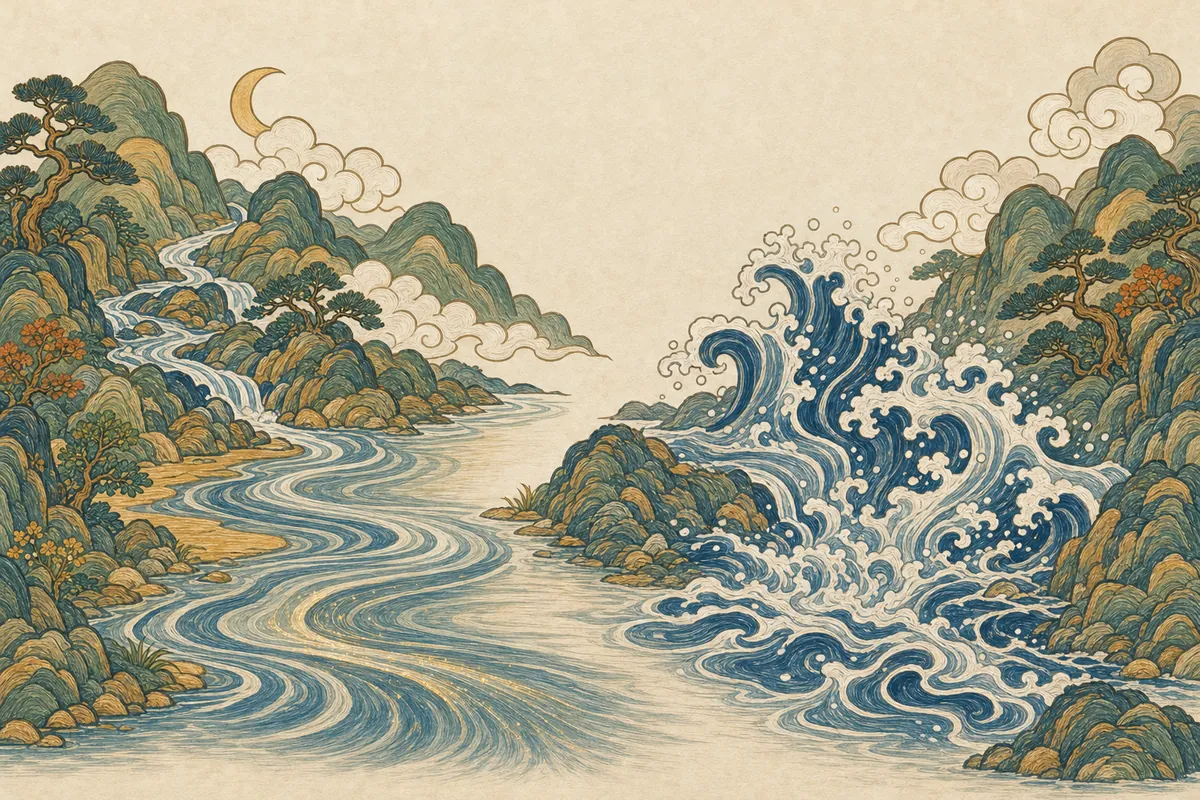
Picture a dinner party. Some guests click right away and end up talking in the kitchen all night. Some can’t agree on anything. A few rub each other the wrong way in small ways nobody else notices. And sometimes three people who barely knew each other team up to plan the whole next party.
Saju characters behave a lot like guests at that party. Some combine, some clash, some create quiet friction. These relationships are where a chart stops being a list and starts being a story.
Quick answer: In Saju, harmony (합) is two characters joining hands and clash (충) is two meeting head-on, pointing to change. Gentler patterns include friction, break, tension and repeating pattern. They show up inside your own chart, between two people’s charts, and across time.
The two big ones: harmony and clash
Harmony (합, hap)
Two characters that naturally join hands. A harmony is a point of connection and cooperation. In Saju’s traditional reading, it’s a flow where the people or areas involved tend to work together.
Among the animals, the six harmony pairs are:
| Pair | Pair | |
|---|---|---|
| Rat + Ox | Snake + Monkey | |
| Tiger + Pig | Horse + Goat | |
| Rabbit + Dog | Dragon + Rooster |
Clash (충, chung)
Two characters that meet head-on. Clash pairs sit directly opposite each other on the wheel of the year, like summer and winter. A clash points to change, movement and rethinking in the area involved. It’s not a disaster sign. Traditional rules say that if you plan ahead, a clash can become an opportunity.
The six clash pairs are:
| Pair | Pair | |
|---|---|---|
| Rat ↔ Horse | Snake ↔ Pig | |
| Ox ↔ Goat | Tiger ↔ Monkey | |
| Rabbit ↔ Rooster | Dragon ↔ Dog |
A helpful way to think about it: harmony is glue, clash is a shake. Both are useful. Glue can also mean getting stuck. A shake can also mean getting unstuck.
The quieter relationships
Saju also names a few gentler patterns. We use softer English names in our readings, with the traditional names beside them:
- Friction (해, 害; traditionally called Harm): two characters slightly out of step. A signal to communicate clearly so small misunderstandings don’t build up.
- Break (파, 破): part of an existing pattern gets broken. Often shows up as reworking an old habit or plan.
- Tension (형, 刑; traditionally called Punishment): pressure that pushes things to adjust, especially around rules, responsibilities and relationships.
- Repeating pattern (자형, 自刑; traditionally Self-Punishment): when one of four characters meets itself: the Dragon, Horse, Rooster or Pig. Quieter than tension: meeting the same task again and again until it’s properly settled.
Groups of three
Some animals also gather into groups of three that pull a whole element together:
- Triple combinations: Monkey–Rat–Dragon (Water), Pig–Rabbit–Goat (Wood), Tiger–Horse–Dog (Fire), Snake–Rooster–Ox (Metal).
- Seasonal combinations: the three animals of one season, like Snake–Horse–Goat (summer Fire).
When two of a triple’s three are present, including its middle animal (the Rat, Rabbit, Horse or Rooster), it’s a half combination: the element starts to gather. When all three are present, the element gathers strongly.
A combination isn’t automatically good. If the element it gathers is one your chart welcomes, it’s helpful. If your chart already has plenty of it, it can feel like too much.
Stems combine and clash too
The top characters (Heavenly Stems) have their own pairs:
- Stem combinations: Yang Wood + Yin Earth, Yin Wood + Yang Metal, Yang Fire + Yin Metal, Yin Fire + Yang Water, Yang Earth + Yin Water. A pull of attraction, like two people whose minds meet, or getting a little attached.
- Stem clashes: Yang Wood vs. Yang Metal, Yin Wood vs. Yin Metal, Yang Fire vs. Yang Water, Yin Fire vs. Yin Water. A pull between directions that asks for a choice.
Three places these show up
1. Inside your own chart
Relationships between your own characters describe your built-in tensions and teamwork. They’re not events; they’re part of your nature.
Our fictional example Leo (June 12, 1994, Seattle) has a Dog–Rabbit harmony (year and hour) and a Dog–Horse half combination gathering Fire. His year stem (Yang Wood) and Day Master (Yin Earth) form a stem combination. There’s also a Horse–Rabbit break, a hint that he tends to rework old plans.
2. Between two people
Compare two charts and look for pairs across them. This is the heart of Korean compatibility, gunghap.
Leo and our other fictional example, Maya (September 21, 1994, Austin), have a harmony between her day branch (Dog) and his hour branch (Rabbit), and stem combinations between her Yang Wood and his Yin Earth Day Master, and between their hour stems. They also have a Rooster–Rabbit clash between her month and his hour. A reader would see natural connection, plus one area (daily rhythms and plans) where they’ll need to talk things through. (Korean Saju Compatibility)
3. Across time
Each year, month and 10-year cycle brings its own characters, which can harmonize or clash with yours. This is how Saju talks about timing.
In 2027, the Goat year:
- For Leo, the Goat harmonizes with his Horse, and it completes a Snake–Horse–Goat seasonal combination with two animals already in his chart. That gathers a lot of Fire, in a chart that already has plenty. A reader would suggest pacing.
- For Maya, the Goat harmonizes with her hour Horse, and forms tension and a break with both of her Dogs. A reader would say: a year that can bring cooperation in her plans, while asking her to rethink some older routines and agreements.
(2027, the Year of the Fire Goat)
How not to read these
- Don’t count harmonies like points. More harmonies doesn’t mean a better chart or a better match.
- Don’t fear clashes. A clash is movement. Many good changes start with one.
- Look at what’s involved. A clash in the pillar of plans is different from a clash in the pillar of roots.
Questions beginners ask
Is a clash in my own chart bad?
No. It’s part of your nature, often a source of drive and change. It just shows where you tend to feel pulled in two directions.
What if this year clashes with my day animal?
Traditionally that points to change around home life and close relationships. Planning ahead and talking things through help you use it well.
Are harmonies always good?
Usually helpful, but a harmony can also mean getting attached or stuck, and a combination that gathers an element your chart already has plenty of can feel like too much.
The short version
- Harmony = joining hands. Clash = meeting head-on, pointing to change.
- Friction, break, tension and repeating pattern are gentler signals.
- Groups of three gather an element, for better or for more.
- These show up inside your chart, between two charts, and across time.
To see how love-related harmonies and clashes show up in your own chart, including the years when your day branch meets a harmony or a clash, see the Love & Soulmate Reading. Or start by finding your four animals free.
What's your real animal?
Free, about 30 seconds, and your birthday never leaves your phone.
Find my real animal