The Wood Element in Saju: Growth, Beginnings and Plans
Wood is the element of growth in Korean Saju: spring, new starts and long-range plans. What it means to have a lot of Wood, a little, or a Wood Day Master, plus simple ways to bring Wood into your days.
Every spring, something pushes up through cracks in the sidewalk. Nobody planted it. Nobody asked it to grow. It just does, bending around whatever’s in the way.
That stubborn, upward push is what Saju calls Wood (목, 木). It’s the element of beginnings, and of people who’d rather start something new than polish something old.
Quick answer: Wood (목) is the Saju element of growth: spring, mornings, beginnings and long-range plans. Yang Wood is a tall tree and Yin Wood is a vine. Plenty of Wood tends to mean big starts and slower finishes; little Wood tends to mean starting takes a moment, and small first steps help.
What Wood means
| Theme | Growth, beginnings, planning |
| Picture | A tree reaching up; a vine finding its way |
| Season | Spring |
| Time of day | Morning |
| Traditional color | Green, teal |
| Direction | East |
| Feeds | Fire (wood burns) |
| Is fed by | Water |
| Keeps in check | Earth (roots push through soil and break it open) |
| Is kept in check by | Metal (shears prune branches) |
Wood is the energy of direction. It asks, “Where are we growing?” It likes plans, learning, mentoring and long projects that get bigger over time.
Two kinds of Wood
Wood shows up as two Heavenly Stems:
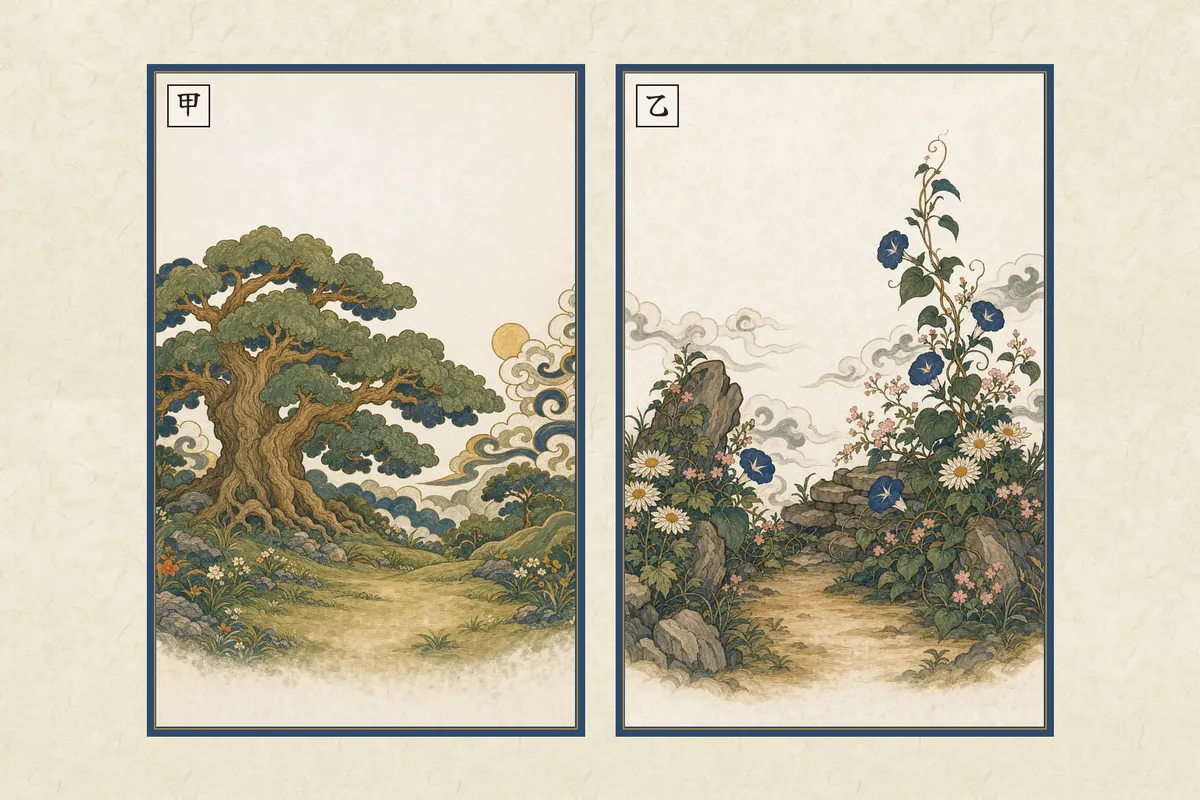
- Yang Wood (甲, Gap): the tall tree. It grows straight up and keeps its direction. Drive, principles, the big plan. Yang Wood Day Master →
- Yin Wood (乙, Eul): grass and vines. It bends around obstacles and still gets where it’s going. Flexibility, persistence, connecting people. Yin Wood Day Master →
A tree and a vine are both alive and both growing. One goes through; the other goes around.
Among the twelve animals, Tiger (寅) and Rabbit (卯) are Wood. Wood also hides inside the Dragon, Goat and Pig, where it waits quietly.
When Wood is plentiful
When a chart has a lot of Wood (three or more Wood characters), Saju traditionally reads a strong urge to start, reach and expand. People with lots of Wood often:
- Love the beginning of things: new projects, new ideas, new plans
- Think in terms of growth and the long game
- Feel restless when nothing is growing
The flip side, in the traditional reading: lots of starts, slower finishes. Many projects get planted and not all get harvested. The balance usually comes from Metal, the element that edits and finishes.
When Wood is scarce
When a chart has little Wood on the surface, Saju traditionally reads that new beginnings or setting a direction can take a bit longer. It isn’t a lack of ambition. It’s more like a car that needs a moment to warm up.
The traditional remedy is simple: break plans into small pieces. Instead of “change careers,” try “take one class.” Small, concrete starts help Wood energy get moving.
One important note: if Wood shows zero on the surface, check the hidden stems before saying “no Wood.” It may be tucked inside a Dragon, Goat or Pig. (Is an Element “Missing”?)
Wood in two real-looking charts
Our fictional example Maya (September 21, 1994, Austin) has one Wood character: the Yang Wood stem on top of her year pillar. She was born in autumn, Metal’s season, when Wood is at its quietest. Her chart welcomes Wood, because her Yang Metal Day Master, near balance but leaning strong, does well with something to shape and grow. For her, Wood activities like learning something new or starting a long project aren’t just nice. They can help her chart breathe.
Leo (June 12, 1994, Seattle) has two Wood characters: the same Yang Wood year stem and a Rabbit in his hour pillar. In his summer chart, that Wood keeps feeding his already strong Fire, so his chart doesn’t especially need more Wood. Same element, different role.
That’s the key idea of the five elements: Wood isn’t good or bad. It depends on what it’s doing in your chart.
Wood at work and in love
At work, Wood tends to show up as planning, teaching, building something from scratch, and growth over time. People with strong or welcomed Wood often enjoy roles where they can see something get bigger because of them.
In love, Wood tends to grow with a partner: making plans together, encouraging each other, learning side by side. (What Your Element Says About Love)
Bringing in Wood
If your chart welcomes Wood, traditional element symbolism suggests simple, everyday ways to bring more of it into your life:
- Colors: green and teal
- Places: parks, woods, rooms with plants; natural materials like wood, paper and natural fibers
- Time: spring, and mornings
- Activities: learning, starting things, long-term projects you grow, mentoring someone
- Direction: east (if you like directional symbolism: a desk facing east, a morning walk toward the sunrise)
These aren’t magic. They’re small cues that nudge your days toward the kind of energy your chart likes. Think of them as setting the scene.
The simplest Wood practice of all? Start one small thing in the morning.
Questions beginners ask
I have lots of Wood but a Metal Day Master. Am I a Wood person?
You’re a Metal Day Master with a lot of Wood around you. In that chart, Wood plays a specific role (for Metal, it’s Wealth & Opportunity), which a full reading explains.
Is lots of Wood good?
It’s good at starting and growing things. Whether you need more or less depends on the rest of your chart.
What does a Wood year mean?
It brings growth and beginning energy. How it lands depends on whether your chart welcomes Wood.
The short version
- Wood = growth, beginnings, plans. Spring and mornings.
- Yang Wood is a tree; Yin Wood is a vine.
- Lots of Wood: big starts, slower finishes. Little Wood: start small.
- Whether you need more Wood depends on your whole chart.
Curious where Wood sits in your chart? Find your Day Master free. And if you’d like to know which elements your chart welcomes, and simple ways to bring them into your week, the Korean Saju Birth Chart Reading includes them.
Keep reading: The 5 Elements in Saju · The Fire Element · The Metal Element
What's your real animal?
Free, about 30 seconds, and your birthday never leaves your phone.
Find my real animal