
Strong or Weak Day Master? What It Means (and Doesn't) in Saju
In Korean Saju, a 'strong' or 'weak' Day Master (신강·신약) isn't about willpower. It describes how much support your core character gets, and it helps decide which elements your chart welcomes. A plain-English guide with examples.
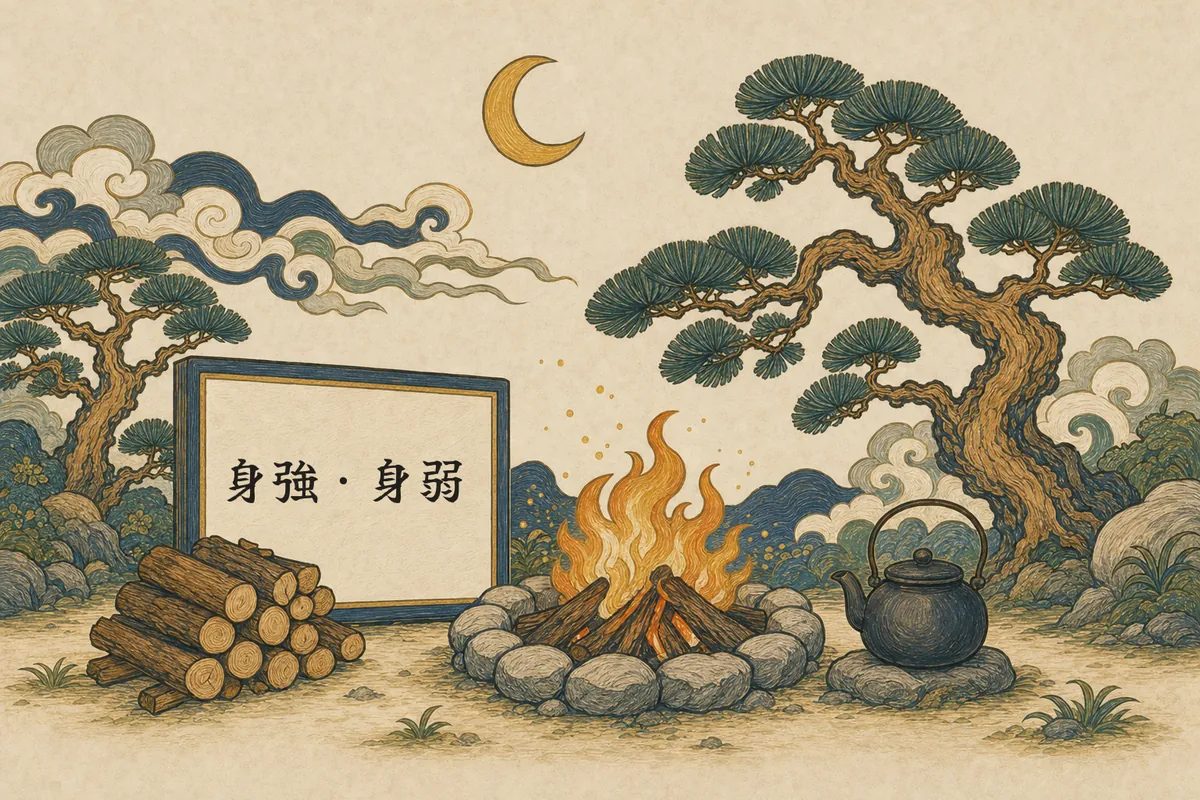
Hear that your Day Master is “weak” and it’s natural to flinch. Weak? Me? Hear that it’s “strong” and you might feel a small, unearned glow of pride.
Neither reaction fits. In Saju, strength isn’t about willpower, talent or character. It’s a measure of how much backup your Day Master has in the chart. And it’s one of the most useful things to know, because it helps decide which elements your chart welcomes.
Quick answer: A strong Day Master (신강, singang) has lots of support from its own element and the element that feeds it; a weak one (신약, sinyak) has more elements drawing on it. Neither is better. A strong Day Master usually welcomes elements that give its energy somewhere to go; a weak one usually welcomes elements that support it.
A campfire, not a grade
Picture your Day Master as a campfire.
- Lots of dry wood stacked around it: the fire is strong. It doesn’t need more fuel. It needs something to do: a pot to boil, people to warm.
- Damp ground, wind, a big pot pulling heat away: the fire is weaker. It needs fuel and shelter first.
Both fires can cook dinner. They just need different things to do it well.
What counts as support
Every character in your chart either helps your Day Master or draws on it:
- Helpers: your own element (peers), and the element that feeds yours (support).
- Draws: the element you feed (output), the element you control (wealth), and the element that controls you (structure).
So for a Metal Day Master, Metal and Earth help; Water, Wood and Fire draw on it. (The 5 Elements in Saju)
Not every position counts the same
Readers don’t just count. Some spots matter more:
- The month animal counts most, because it sets your birth season. A Day Master born in its own season starts out well supported.
- Hidden stems inside the animals count too, a little each.
- Stems on top count as single, clear voices.
Different schools weigh these differently, which is why one reader may call a chart “balanced” and another “slightly strong.” Charts near the middle are genuinely close calls. That’s why we use five steps instead of two:
| Level | In plain English |
|---|---|
| Strong | Clearly well supported |
| Near balance, leaning strong | Close to the middle, tipping toward support |
| Near balance | Support and draw about even |
| Near balance, leaning weak | Close to the middle, tipping toward draw |
| Weak | Clearly more draw than support |
What strength changes: the elements your chart welcomes
This is the practical payoff. In Korean this idea is often discussed as yongsin (용신), the “useful element.” We call it the elements your chart welcomes. In deeper Saju schools, choosing a useful element can be more complex; “welcomed elements” is our beginner-friendly way to describe the balancing elements a reading identifies.
- Strong: welcomes outlets: output, wealth or structure. Energy wants a job.
- Weak: welcomes support: its own element and the element that feeds it.
- Near balance: often welcomes whatever is quietest, to round things out.
There’s a second, separate reason a chart may welcome an element: climate. A chart born in deep summer with lots of Fire may welcome Water to cool it, whatever its strength. A winter chart with no Fire may welcome warmth. Good readers keep these two reasons apart, because they can point to different elements.
Three examples
Leo (fictional, June 12, 1994, Seattle) is a Yin Earth Day Master born in the midsummer Horse month, with three Fire characters feeding his Earth and no Water at all.
- Strength: strong. Fire feeds Earth, and summer Fire is powerful.
- Welcomed by strength: Water and Metal, outlets for all that energy.
- Welcomed by climate: Water and Metal again, to cool a hot summer chart.
Both reasons agree, which makes his chart’s needs unusually clear.
Maya (fictional, September 21, 1994, 2:20 p.m., Austin) is a Yang Metal Day Master born in autumn, Metal’s own season.
- Strength: near balance, leaning strong.
- Welcomed: Wood and Fire, the quietest of her outlets.
Maya without her birth time. If we drop her hour pillar (a Water Horse), her chart loses a Water stem that was drawing on her Metal and the one visible Fire. Now:
- Strength: strong.
- Welcomed: Fire and Water.
Two characters changed the verdict by a step. That’s how sensitive charts near the middle can be, and why an honest reading shows its reasoning.
Why “weak” isn’t bad
A weak Day Master tends to draw strength from supportive seasons: periods of learning, guidance and allies. That’s a statement about the chart’s balance, not about how capable someone is.
A strong Day Master tends to do well in seasons that give its energy an outlet: expression, practical opportunities, responsibility. Traditionally, that’s when ability most easily turns into results.
Saju describes both as natural shapes. Neither is a flaw.
How strength shows up in timing
Once you know what your chart welcomes, the years and 10-year cycles make more sense. A cycle that brings welcomed elements tends to feel supportive. One that piles on what you already have plenty of tends to ask for pacing.
Leo’s current cycle (from about 2022) brings Water over Metal, exactly what his chart welcomes. (Luck Cycles: Your 10-Year Seasons)
Common mix-ups
- “Weak Day Master = weak person.” It’s about chart support, not character.
- “Strong is better.” Strong charts can feel restless without an outlet; weak charts can thrive with the right support.
- “Just add the element you’re missing.” What a chart welcomes depends on strength and season, not only on what’s missing.
Questions beginners ask
Can my Day Master’s strength change?
Your birth chart doesn’t change, but years and cycles add support or draw. So you may feel stronger or more stretched in different seasons of life.
Why do two calculators disagree about my strength?
They may weigh positions and hidden stems differently, especially for charts near balance. That’s normal; look for one that explains its method.
Is yongsin the same as a lucky element?
Close, but “lucky” oversells it. It’s the element that tends to bring your chart toward balance, and it works best as a guide for habits and timing, not as a charm.
See where yours lands
You can find your Day Master free. For your strength level, the elements your chart welcomes (and why), plus everyday ways to bring them in, see the Korean Saju Birth Chart Reading.
What's your real animal?
Free, about 30 seconds, and your birthday never leaves your phone.
Find my real animal