How to Read Your Saju Chart, Step by Step (With a Full Example)
A beginner's walkthrough of reading a Korean Saju chart in eight steps, from Day Master to luck cycles, using one complete example chart and showing what's calculated, what's a traditional rule, and what's interpretation.
Most Saju guides explain the pieces: stems, branches, elements, Ten Gods. Then they stop, right before the part you actually want, which is putting the pieces together. It’s like learning every chess piece’s moves and never seeing a game.
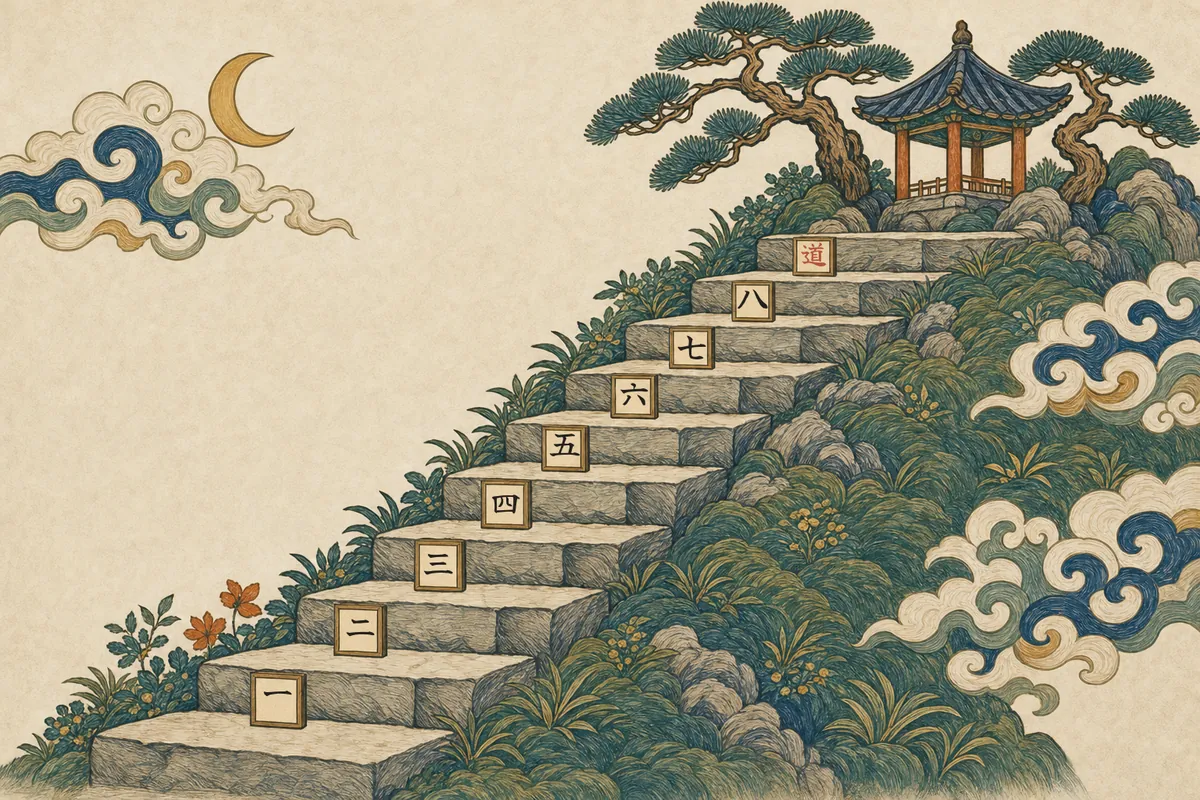
So let’s play a whole game. We’ll read one complete chart, start to finish, in eight steps.
Quick answer: To read a Saju chart, start with the Day Master (the character that stands for you), then the birth season, then the element count and hidden stems, then the Day Master’s strength and the elements the chart welcomes. After that, look at the Ten Gods, the relationships between characters, and finally timing: 10-year cycles and the current year.
Three kinds of statements
Before we start, one habit that will make you a better reader than most: notice what kind of statement you’re making.
- Calculated: a fact anyone using the same rules will get. “Maya’s Day Master is Yang Metal.”
- Traditional rule: what Saju’s rules say a pattern tends to mean. “Plenty of Metal tends to mean clear judgment.”
- Interpretation: how we put rules into words for one person. “Maya likely decides fast and explains later.”
Good readings keep these honest. A calculated fact is certain. A rule is a tradition. An interpretation is a suggestion to check against real life.
Our example chart
Maya is a fictional example, born September 21, 1994, at 2:20 p.m. in Austin, Texas.
| Hour | Day | Month | Year | |
|---|---|---|---|---|
| Stem | 壬 Yang Water | 庚 Yang Metal | 癸 Yin Water | 甲 Yang Wood |
| Branch | 午 Horse | 戌 Dog | 酉 Rooster | 戌 Dog |
Calculated with the Start of Spring as the new year, solar-term months, and her birth time adjusted to local solar time (about 12:49 p.m.), which puts her hour in the Horse block. (What Are the Four Pillars?)
Beginner note: you don’t need to memorize this. The point is the order: self, season, balance, roles, timing.
Step 1: Find the Day Master
The top of the day pillar: 庚, Yang Metal. Raw ore, a strong blade.
Traditional rule: Yang Metal is linked with decisiveness, loyalty and clear lines. (The 10 Day Masters)
Everything else in the chart will be read in relation to this one character.
Step 2: Check the season
The month animal is the Rooster (酉): mid-autumn, Metal’s own season.
Traditional rule: autumn is the season of harvest, clearing and deciding. A Metal Day Master born in autumn is in its home season, so it tends to be well supported.
Think of a plant in its ideal month. It doesn’t need much help to stand up.
Step 3: Count the elements, then check what’s hidden
Count all eight characters:
| Wood | Fire | Earth | Metal | Water |
|---|---|---|---|---|
| 1 | 1 | 2 | 2 | 2 |
Every element appears, and none has three or more. That’s a fairly even spread.
Now the hidden stems inside each animal:
- Dog (戌): Metal, Fire, Earth (twice, since she has two Dogs)
- Rooster (酉): Metal
- Horse (午): Fire, Earth
So beneath the surface there’s a bit more Metal, Fire and Earth. Nothing is “missing.” (Is an Element “Missing”?)
Step 4: How strong is the Day Master?
This step asks: how much of the chart supports Yang Metal, and how much draws on it?
- Supporting: Metal (same element) and Earth (Earth feeds Metal). She has her Rooster, two Dogs, and Metal hidden in the Dogs. And her month animal, the most heavily weighted spot, is Metal.
- Drawing on her: Water (which Metal feeds), Wood (which Metal cuts), Fire (which shapes Metal).
Calculated (using Pathlight’s weighting method): Maya’s Day Master is near balance, leaning strong. (Strong or Weak Day Master?)
Step 5: Which elements does the chart welcome?
A Day Master that leans strong usually welcomes elements that give its energy somewhere to go. Of those outlets, her chart has the least Wood and Fire (one each).
Traditional rule, applied: Maya’s chart welcomes Wood and Fire.
Interpretation: Wood is something for the blade to shape (projects, growth, people to work with). In Ten Gods language, Wood is the element Metal manages, so it often points to projects, resources and practical opportunity. Fire is the forge that refines it (being seen, presenting, warmth).
Step 6: Give every character a role (Ten Gods)
Now each character gets a role relative to Yang Metal. (Ten Gods, Simply)
| Character | Role |
|---|---|
| 甲 year stem | Opportunity Wealth |
| 戌 year branch | Intuitive Insight |
| 癸 month stem | Expression & Change |
| 酉 month branch | Competing Peers |
| 戌 day branch | Intuitive Insight |
| 壬 hour stem | Creative Output |
| 午 hour branch | Recognition & Responsibility |
Grouped: Expression & Output 2, Support & Learning 2, and one each of Self & Peers, Wealth & Opportunity, and Structure & Recognition.
Interpretation: two kinds of output (steady work and bold ideas), a deep and unusual way of learning (two Dogs as Intuitive Insight), and a work life shaped by peers and some healthy competition (the month Rooster).
Step 7: Look at relationships between characters
Calculated:
- Dog and Rooster: Friction (traditionally called Harm, 害), twice (year–month and month–day)
- Yang Wood and Yang Metal: Stem Clash (year stem and Day Master)
- Dog and Horse: Half Combination, gathering Fire (year–hour and day–hour)
Traditional rules: friction is a cue to communicate clearly; a stem clash asks for choices between directions; a half combination gathers an element.
Interpretation: Maya may sometimes feel pulled between her own direction and what her background expects (the year–day clash). Saying things plainly prevents small misunderstandings piling up (the frictions). And her Dogs and Horse quietly pull together some of the Fire her chart welcomes. (Harmonies and Clashes)
Step 8: Add timing
Calculated: Maya’s 10-year Luck Cycles move in reverse order through the 60-pair cycle, beginning around age 5. Her current cycle is 庚午 (Metal Horse), from about 2019, and the next, 己巳 (Earth Snake), begins about 2029.
- Current cycle roles: Peer Energy and Recognition & Responsibility.
- 2027 (丁未): Recognition & Responsibility and Study & Support, with Fire she welcomes, a harmony with her Horse, and tension plus a break with her two Dogs.
Interpretation: a decade about standing on her own and earning trust in a role; a 2027 that can bring visibility and learning while asking her to rework some older routines. (Luck Cycles · 2027, the Year of the Fire Goat)
Putting it into words
Here’s how those eight steps might become a short summary:
Maya is a Yang Metal Day Master born in her own season: decisive, loyal and clear, with a chart where every element shows up. Her strength leans slightly strong, so she does best with something to shape (Wood) and a little heat to refine her (Fire): projects that grow, and places where her work is seen. She produces in two ways, steady and bold, and learns in an unusual, intuitive way. Her current decade asks her to earn trust in a role, and the next one, from about 2029, adds support and learning alongside more responsibility.
Notice there are no guarantees in it. Every line is either a fact, a rule, or a suggestion she can test.
Common beginner mistakes
- Skipping the season. The same Day Master reads very differently in summer and winter.
- Counting and stopping. Hidden stems and strength change the picture.
- Reading one clash as a disaster. It’s a point of movement, not a verdict.
- Reading timing without the birth chart. A year means nothing until you know which chart it’s meeting.
Questions beginners ask
Do I need to do all eight steps?
For a first look, steps 1 to 5 already tell you a lot. Ten Gods, relationships and timing add depth.
What if I don’t know my birth time?
Do the same steps with six characters, and be careful with strength and welcomed elements; the hour can shift them. (What If You Don’t Know Your Birth Time?)
How do professionals weigh things?
Schools differ, especially on strength and which elements to favor. That’s why a good reading says how it reached a conclusion, not just what it concluded.
Try it on your own chart
Get your chart free, then walk through the eight steps. If you’d like the whole thing done for you, with every step explained in plain English and “Seen in the chart” notes that show which characters each point comes from, the Korean Saju Birth Chart Reading is built exactly this way.
What's your real animal?
Free, about 30 seconds, and your birthday never leaves your phone.
Find my real animal