Is Saju Fortune Telling? Reading It for Reflection, Not Fixed Fate
Is Korean Saju fortune telling? An honest look at what a Saju chart can and can't tell you, why good readings avoid guarantees, and how to use it as a tool for reflection.
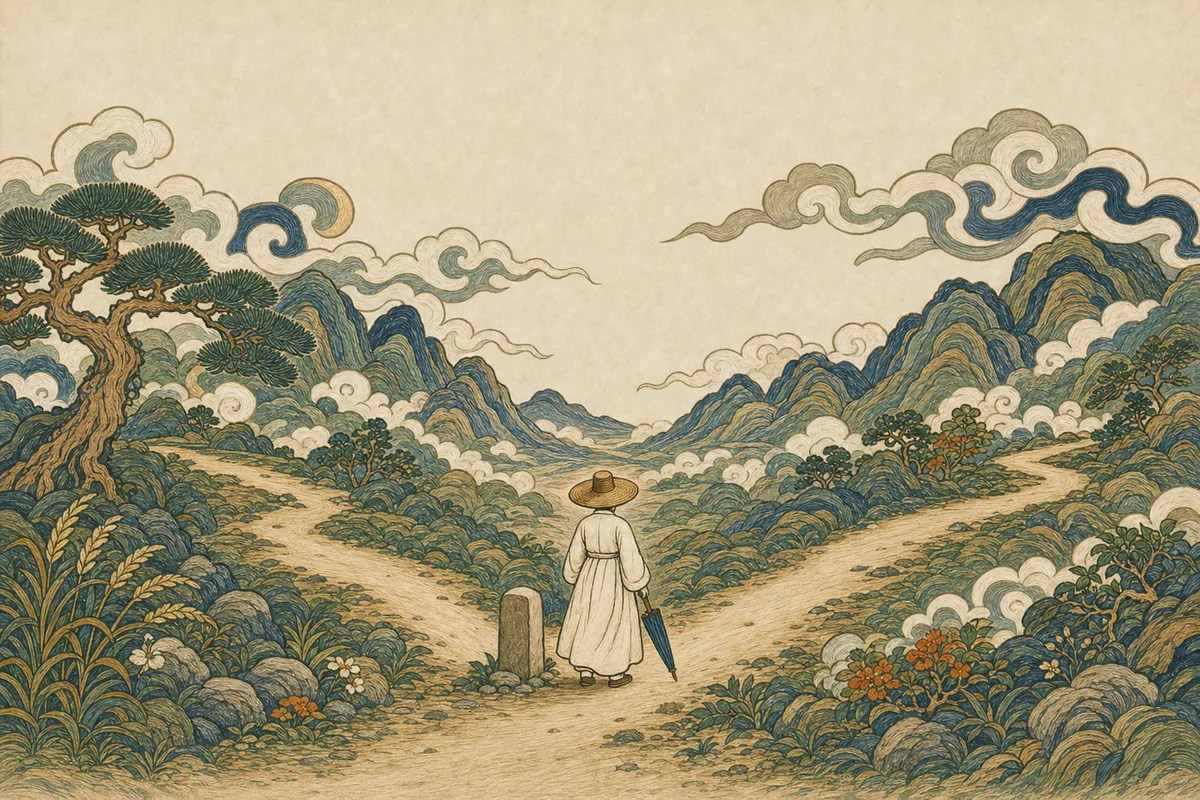
There’s an old Korean expression for when life goes sideways: “It must be my palja.” My eight characters. It sounds like surrender, like fate decided and you just live it out.
But spend time with people who actually read Saju, and you’ll hear something different. A good reader rarely says “this will happen.” They say “this is the kind of season you’re in” or “this is a pattern worth watching.” That’s a very different thing.
So, is Saju fortune telling? Let’s be honest about it.
Quick answer: Saju can be used as fortune telling, but it works best as a tool for reflection. A chart describes tendencies and the kind of season you’re in. It can’t guarantee events, dates or outcomes.
What a chart actually is
A Saju chart is eight characters calculated from your birth date, time and place. The calculation is exact: anyone using the same rules gets the same chart.
The interpretation is where meaning comes in. Saju’s traditional rules say things like:
- Lots of one element tends to show up as a strong trait, with a matching blind spot.
- A clash between two characters points to change, movement or rethinking in that area.
- A certain kind of year tends to bring more responsibility, or more learning, or more competition.
Notice the words: tends to, points to, more. These are patterns and tendencies, not events.
Weather, not a script
The most useful way to think about Saju is as a weather report.
A forecast that says “heavy rain likely Tuesday” doesn’t tell you what you’ll do on Tuesday. It doesn’t promise rain, either. It tells you to pack an umbrella, maybe move the picnic. You still decide.
Saju works like that. A chart might say a period favors learning and preparation over big launches. It can’t say you’ll get a promotion on a certain date, meet a soulmate in March, or that money will arrive. And any reading that says it can is overselling.
What a good reading will never say
Here’s a quick list. If a reading says any of these, be careful:
- Guarantees. “You will definitely get rich.” “This marriage is guaranteed.”
- Exact event dates. “You’ll meet your partner on June 3.”
- Health, illness, death or pregnancy predictions. These are not something a chart should be used for.
- Fear. “This year is a disaster for you.” “Your chart is cursed.” Saju doesn’t have cursed charts.
- Pressure to buy. Charms, rituals or expensive “fixes” to avoid a bad outcome.
A good reading talks about tendencies, gives you language for your strengths and challenges, and suggests something you can actually do.
Why do so many people find it useful?
A few reasons come up again and again:
- It gives you words for patterns. “You start fast and finish slow” sounds like a criticism from a friend. “Your chart has lots of Wood and little Metal” is easier to hear, and it points to a fix: set deadlines.
- It invites reflection. Reading about yourself from an outside angle makes you ask, “Is that true? Where does that show up?”
- It thinks in seasons. Knowing you’re in a “preparing” chapter, not a “harvesting” one, can make a slow year feel less like failure.
- It’s a conversation starter. In Korea, Saju often comes up between friends, couples and family as a way to talk about big decisions.
Two charts, one lesson
Look at our two fictional examples, both born in 1994.
Leo (June 12, Seattle) has a chart with three Fire characters, a summer birth, and no Water. A fear-based reading might say “dangerously out of balance.” A good reading says something like: you likely run warm and move fast; build in cooling habits, real rest, and time near water; take on work that gives your energy somewhere to go. Same chart. One version scares you. The other is useful.
Maya (September 21, Austin) meets 2027 with a mix of signals: Fire she welcomes, plus a “tension” pattern between the year’s Goat and her Dog. A fortune-teller might pick one and announce good or bad luck. A careful reading holds both: a year that can bring a more visible role and real learning, while asking you to adjust some old routines and agreements. You can work with that.
So… is it fortune telling?
It depends on how it’s used.
Used to predict fixed events, Saju becomes fortune telling, and it promises more than any chart can deliver.
Used to understand yourself and think about timing, it’s closer to a mirror with a calendar attached. It shows you a picture of your tendencies, and gives you a rough sense of which seasons are good for pushing and which are good for pausing.
That second way is how many Koreans use it, and it’s how we write our readings.
Questions beginners ask
Is Saju scientifically proven?
No. It’s a traditional system, and we offer it for reflection and entertainment, not as science or professional advice.
What if a reading says something I don’t like?
Treat it as a tendency worth checking against your real life, not a sentence. A good reading always pairs a caution with something practical you can do.
Can I change my Saju?
Your chart stays the same, but your choices, habits and timing are yours. Saju is more like knowing the weather than being told where to go.
A healthy way to read your chart
- Read it like a letter from a thoughtful friend, not a verdict.
- Keep what resonates. Question what doesn’t.
- Use it to plan, not to panic.
- Remember that the choices stay yours. Two people with nearly the same chart can live very different lives.
If you’d like to try that kind of reading, start by finding your Day Master free, the character from your birth day that stands for you. Our Korean Saju Birth Chart Reading is written in that same spirit: tendencies and timing, never fixed fate, with a practical step wherever your chart asks for care.
Keep reading: Where Saju Comes From · Luck Cycles: Your 10-Year Seasons
What's your real animal?
Free, about 30 seconds, and your birthday never leaves your phone.
Find my real animal