What Is Saju? A Simple Guide to Korean Four Pillars
Saju (사주) is Korean Four Pillars astrology: your birth year, month, day and hour turned into eight characters. Where it came from, how it works, and the few rules that make it different.
In Korea, a couple might mention over dinner that they “had their saju looked at” before picking a wedding date. Nobody at the table blinks. It’s a bit like an American couple saying they did a personality quiz together, except the Day-Master method behind modern Saju is about a thousand years old, and its calendar roots go back much further.
So what are they actually looking at? Not a horoscope column, and not just a zodiac animal. They’re looking at a small chart of eight characters that comes from the moment each of them was born.
Quick answer: Saju (사주) is Korean Four Pillars astrology. It turns your birth year, month, day and hour into eight characters, then reads how their five elements balance around the one character that stands for you, your Day Master. It describes tendencies and timing, not fixed fate.
The name says it all
Saju is the Korean name, and the Korean style of practice, for the East Asian Four Pillars system that’s often called BaZi in English. Saju (사주, 四柱) means “four pillars.” Each pillar is one unit of time from your birth:
- the year you were born
- the month
- the day
- the hour
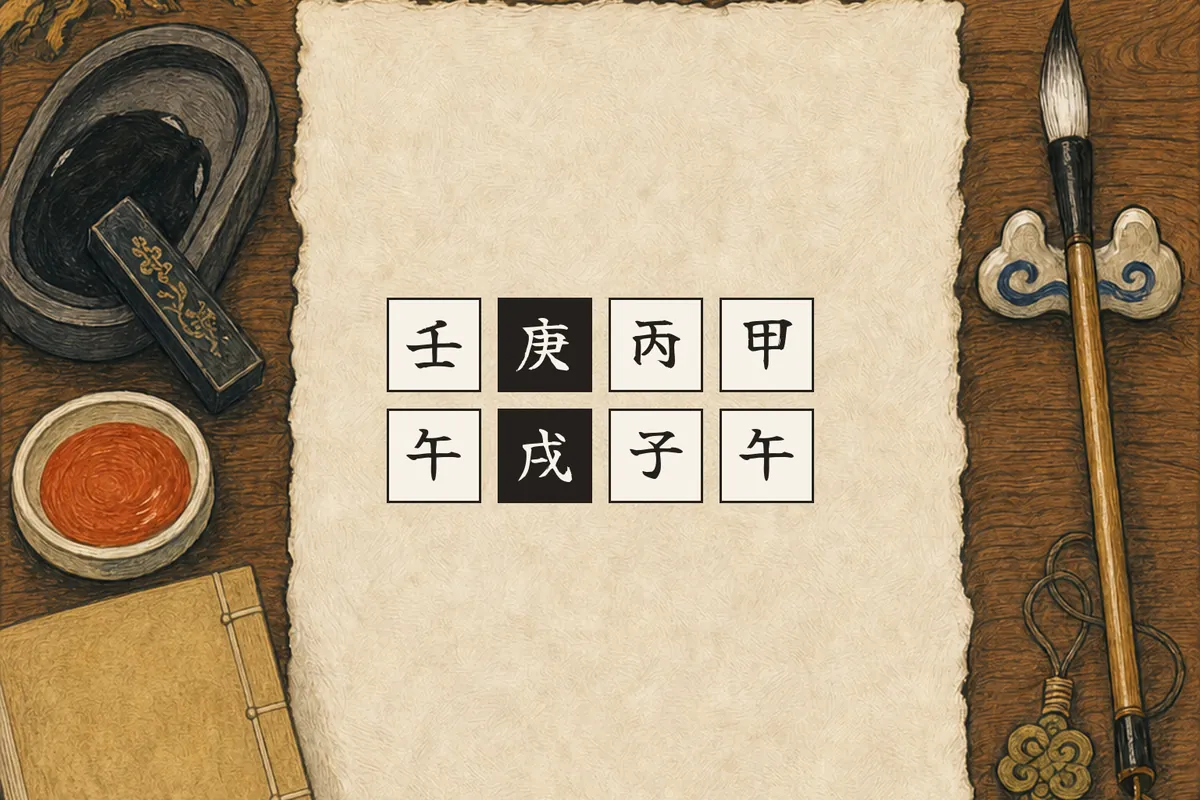
Each pillar holds two characters, one on top and one on the bottom. Four pillars times two characters gives you eight. That’s why Koreans often say saju palja (사주팔자), “four pillars, eight characters.” In everyday Korean, palja has even become a casual word for “your lot in life,” the way English speakers say “that’s just my luck.”
Think of your chart as a small house with four rooms. Each room has a ceiling and a floor. Saju reads what’s in every room, and how the rooms sit next to each other. (For a closer look at each pillar, see What Are the Four Pillars?.)
What the eight characters are made of
The top character in each pillar is a Heavenly Stem. There are ten of them. The bottom character is an Earthly Branch. There are twelve, and each one is paired with an animal: Rat, Ox, Tiger, Rabbit, and so on.
Every stem and branch belongs to one of the five elements: Wood, Fire, Earth, Metal and Water. Most of a Saju reading comes down to a simple question: which elements are strong in this chart, which are quiet, and how do they get along?
The elements relate in two basic ways. One feeds the next, like a cycle: Wood feeds Fire, Fire makes Earth, Earth holds Metal, Metal carries Water, and Water grows Wood. And each one also keeps another in check, the way a riverbank keeps water from flooding. A chart doesn’t need to be “perfect.” Saju cares more about balance than about having good or bad elements. (The 5 Elements in Saju goes deeper.)
The most important character: your Day Master
Of all eight characters, one gets special attention: the top character of your day pillar. It’s called your Day Master, and it stands for you. Everything else in the chart is read in relation to it.
There are ten possible Day Masters, from Yang Wood (a tall tree) to Yin Water (rain and dew). If you only learn one thing about your chart, learn this one. You can find your Day Master free in under a minute.
A few rules that make Saju its own system
Saju runs on a calendar that’s a little different from the one on your phone. Three rules matter most:
- The year starts at the Start of Spring (입춘, Ipchun), around February 4, not January 1 and not Lunar New Year. Someone born on January 20 belongs to the previous Saju year. (Born before February 4? explains this.)
- Months follow the solar terms. The Saju month changes when the sun reaches certain points in its yearly path, usually somewhere between the 4th and the 8th of a calendar month.
- Hours come in two-hour blocks, each tied to an animal. A careful chart also adjusts your clock time to your birthplace’s longitude (local solar time), because noon on the clock isn’t always noon by the sun.
These rules are why two calculators can give different answers. A calculator that uses January 1 or Lunar New Year for the year change will get some birthdays wrong.
Where it came from
Saju grew out of the Chinese study of fate and timing, often called myeongni (명리, 命理) in Korean and better known in English as Four Pillars of Destiny or BaZi. The method of reading a chart from the Day Master is usually credited to scholars of China’s Song dynasty, about a thousand years ago.
The system traveled to Korea and became part of Korean life. During the Joseon dynasty, the royal office in charge of astronomy and the calendar also trained specialists in fate calculation. Today it lives on in street-corner fortune tents, “saju cafés” where friends get readings over tea, and smartphone apps. (Where Saju Comes From tells the longer story.)
What Saju is (and isn’t)
Saju is a language for patterns: how you tend to act, what kind of work drains or energizes you, which seasons of life ask for pushing and which ask for patience.
What it isn’t: a script for your life. A good reading talks in tendencies and timing, never guarantees. Two people with similar charts can make very different choices and live very different lives. Many Koreans use Saju the way you might use a long talk with a wise aunt: to think more clearly, not to hand over the steering wheel. (Is Saju Fortune Telling? looks at this question honestly.)
A quick example
Meet Maya, a fictional example born September 21, 1994, at 2:20 p.m. in Austin, Texas. Her Saju chart is:
Beginner note: Korean charts list the pillars hour, day, month, year, so the year comes last.
| Pillar | Characters | In English |
|---|---|---|
| Hour | 壬午 | Water Horse |
| Day | 庚戌 | Metal Dog |
| Month | 癸酉 | Water Rooster |
| Year | 甲戌 | Wood Dog |
If Maya only knew her zodiac sign, she’d say “I’m a Dog.” True, but her Day Master is Yang Metal (庚), often pictured as raw ore or a strong blade: decisive, loyal, clear about where lines are drawn. Her chart also shows all five elements, with no single one taking over. That’s already a richer picture than one animal can give.
Common mix-ups
- “My zodiac animal is my Saju.” It’s one character out of eight, and not the most personal one. (Your Zodiac Sign Is Only 1 of Your 8 Characters)
- “Saju runs on the lunar calendar.” Its months follow the sun’s solar terms, and its year starts at the Start of Spring. You enter your regular birthday. (Lunar or Solar Birthday?)
- “Some charts are good and some are bad.” Every chart has strengths and blind spots. Saju is about balance, not grades.
- “A reading tells you what will happen.” It describes the kind of season you’re in. What you do with it is yours.
Questions beginners ask
Is Saju the same as Chinese BaZi?
They share the same roots and the same calculation: four pillars, ten stems, twelve branches, five elements. “Saju” is the Korean name. In Korea, readings often focus on practical things like work, relationships and timing, though every reader’s style is different.
Do I need my birth time?
It helps, because it adds the last two of your eight characters. Without it you still have six, including your Day Master. (What If You Don’t Know Your Birth Time?)
What should I learn first?
A good order is: your Day Master, then your birth season, then your element balance, then the Ten Gods, then your 10-year Luck Cycles. How to Read Your Saju Chart, Step by Step walks through it with an example.
Is Saju a religion?
No. It’s a calendar-based system for describing patterns. In Korea it sits alongside other fortune traditions like shamanism, tarot and face reading, but it works differently from all of them.
Where to go next
If this is your first time hearing about Saju, a good path is:
And if you’d like your whole chart read in plain English, with every Korean term explained, the Korean Saju Birth Chart Reading is made from your exact birth date, time and city.
What's your real animal?
Free, about 30 seconds, and your birthday never leaves your phone.
Find my real animal