Where Saju Comes From: A Short History of Korean Four Pillars
From Chinese calendar scholars to Joseon court specialists to Seoul's saju cafés: a short, friendly history of Saju, and how Koreans still use it before weddings, new jobs and the new year.
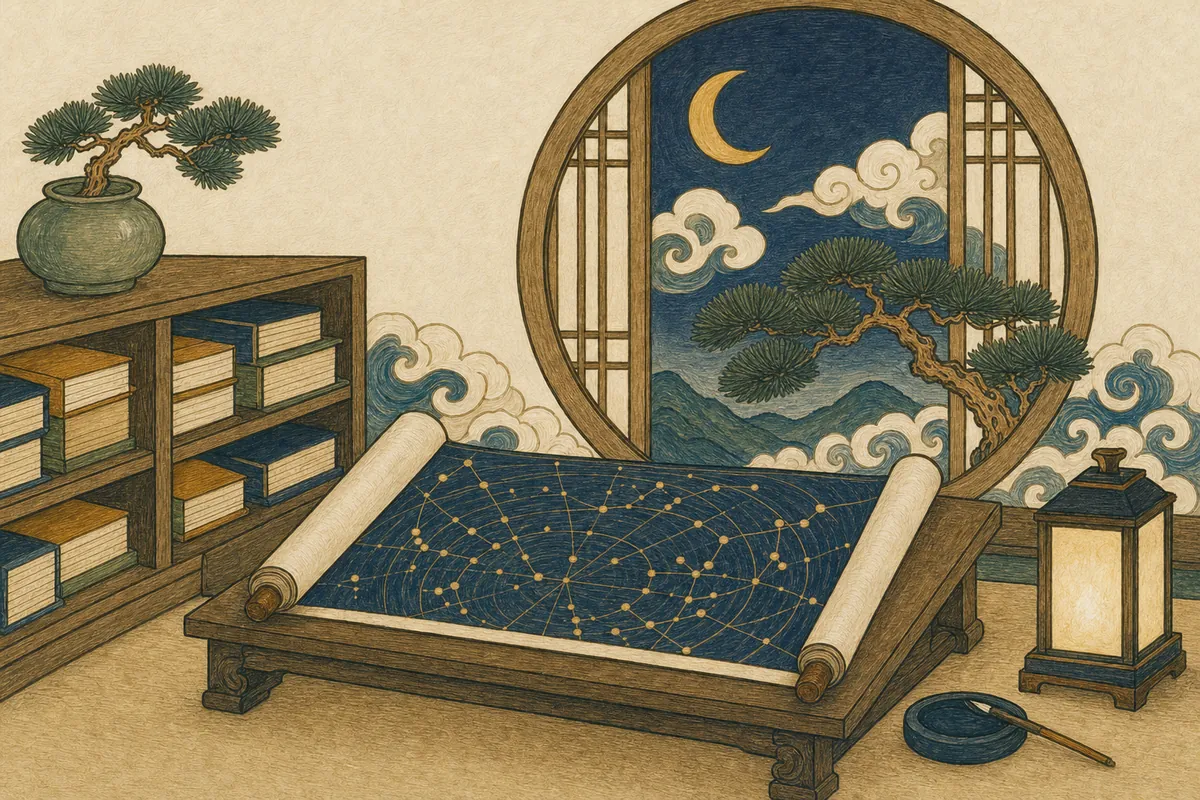
Walk through a busy neighborhood in Seoul in the evening and you might pass a small café with a sign offering saju and tea. Inside, two friends are sitting across from a reader who’s writing eight characters on a sheet of paper and tapping them with a pen. They’re not there for a prophecy. They’re there to talk about whether to change jobs.
That scene is the newest chapter of a very old story.
Quick answer: Saju comes from the Chinese study of fate and timing (myeongni), built on a calendar of stems and branches that is thousands of years old. The Day-Master method took shape about a thousand years ago and became part of Korean life, from Joseon court specialists to today’s saju cafés and apps.
The roots: calendars, not crystal balls
Saju’s raw materials, the ten Heavenly Stems and twelve Earthly Branches, are some of the oldest counting tools in East Asia. In ancient China, the stems and branches were used to name days in a repeating 60-day cycle more than three thousand years ago. Over time, the same cycle came to name years, months and hours too.
That’s an important point: Saju’s building blocks were used for keeping time: naming days, then years, months and hours. The method of reading a whole life from them came much later.
Reading a life from birth time
By around the Tang dynasty (roughly 1,200 years ago), Chinese scholars were reading people’s lives from the stems and branches of their birth. Early methods focused mostly on the year of birth.
The big shift is usually credited to the Song dynasty, about a thousand years ago, when the method moved its center from the birth year to the birth day. The top character of the day pillar, the Day Master, became the “self” that everything else is measured against. That’s still how Saju works today. The study became known as myeongni (명리, 命理), roughly “the principles of fate,” and in English it’s often called Four Pillars of Destiny or BaZi.
Beginner note: you don’t need to remember dynasties or dates. The big picture is a calendar that slowly became a way of reading lives.
Saju in Korea
Like many ideas from China, including writing, Confucian learning and medicine, the four-pillar method traveled to Korea and became part of Korean life.
During the Joseon dynasty (1392–1910), the royal office for astronomy and the calendar didn’t only track the stars and print the official almanac. It also trained specialists in fate calculation, who worked out auspicious dates for royal events. Choosing a good day for a wedding or a ceremony, called taegil (택일), was serious business.
Outside the palace, people turned to fortune-tellers for big life moments. A popular New Year’s custom was reading the Tojeong Bigyeol (토정비결), a book of yearly fortunes credited to a Joseon scholar, to get a feel for the twelve months ahead. Many families still do a version of this around Lunar New Year.
Over the centuries, Korean readers developed their own style: plain-spoken, practical, and deeply tied to everyday questions like marriage, family, work and timing.
Saju before marriage: gunghap
One of the best-known uses of Saju in Korea is gunghap (궁합), comparing two people’s charts before marriage.
Traditionally, once a match was agreed, the groom’s family sent his four pillars to the bride’s family, carefully written on paper and wrapped in cloth. This custom is called saju danja (사주단자). The charts could then be compared, and a wedding day chosen, by looking at how the elements and animals interact.
Today, gunghap is often lighter and more playful. Plenty of couples look up their compatibility for fun, or because a parent asked them to. Some take it seriously; many treat it as one more conversation before a big step. (Korean Saju Compatibility explains what readers actually look at.)
Saju today: cafés, apps and new year’s readings
In modern Korea, where almost everything has an app, Saju has kept up:
- Saju cafés: casual spots where friends get short readings over drinks.
- Apps and websites: free daily fortunes and full chart readings on your phone.
- New year rush: around the solar and lunar new year, readers get busy with people checking their year ahead.
- Big decisions: people check their chart before job changes, moves, starting a business, or naming a baby.
You’ll also hear Saju’s language in daily speech. Saying something is “in your palja (팔자),” your eight characters, is a casual way to say “that’s just how my life goes.” And Korean news will call a year by its Saju name, like 2026’s red horse or 2027’s red goat, since Fire is linked with red.
How Koreans actually feel about it
Attitudes vary a lot. Some people believe in it; many say they don’t but still go before big decisions; others see it as pure entertainment. A common middle view sounds something like: “It’s not that I think it decides my life. It helps me think.”
That middle view is also how we approach it. (Is Saju Fortune Telling? explores this.)
Why it’s catching on outside Korea
K-dramas, K-pop fans and a growing interest in Korean culture have brought Saju to people who’ve never been to Seoul. Many of them already know Western astrology or their zodiac animal, and are curious about a different framework: four birth pillars, a Day Master, and the five elements. (Saju vs Western Astrology compares the two.)
Questions beginners ask
Is Saju Korean or Chinese?
Both, in a way. The method comes from China; “Saju” is how it’s known and practiced in Korea, with its own culture and style of reading.
Is Saju the same as Korean shamanism?
No. Shamanism (musok) works with spirits and rituals. Saju is a calendar calculation read by rules. They often appear side by side in Korean fortune culture and TV shows, which is why people mix them up.
Do young Koreans still use it?
Yes, often through apps, saju cafés and new-year readings, and often more for fun and reflection than for prediction.
The thread through it all
From ancient day-counting to a phone app, one idea has stayed the same: the moment you were born can be written as eight characters, and those characters can be read as a pattern. What people do with that pattern has always been up to them.
If you’d like to see your own eight characters, you can find your Day Master free. And if you’d like them read in the Korean style, practical and plain-spoken, the Korean Saju Birth Chart Reading explains your chart in everyday English.
Keep reading: What Is Saju? · Korean Saju Compatibility
What's your real animal?
Free, about 30 seconds, and your birthday never leaves your phone.
Find my real animal