Saju vs Western Astrology: What's Different?
Western astrology reads the planets. Korean Saju reads time itself, as eight characters and five elements. A friendly side-by-side for anyone who already knows their sun, moon and rising.
If you know your sun, moon and rising signs, you already have a head start on Saju. Both systems take the moment you were born and turn it into a map. Both say your birth time matters. Both get more interesting the deeper you go.
But they’re built on very different foundations. One looks up at the sky. The other reads time itself.
Quick answer: Western astrology maps where the sun, moon and planets were when you were born. Saju doesn’t use planets: it turns your birth year, month, day and hour into eight characters from an old calendar and reads how their five elements balance around your Day Master.
The one-sentence difference
- Western astrology maps where the sun, moon and planets were, against the zodiac, from where you were born.
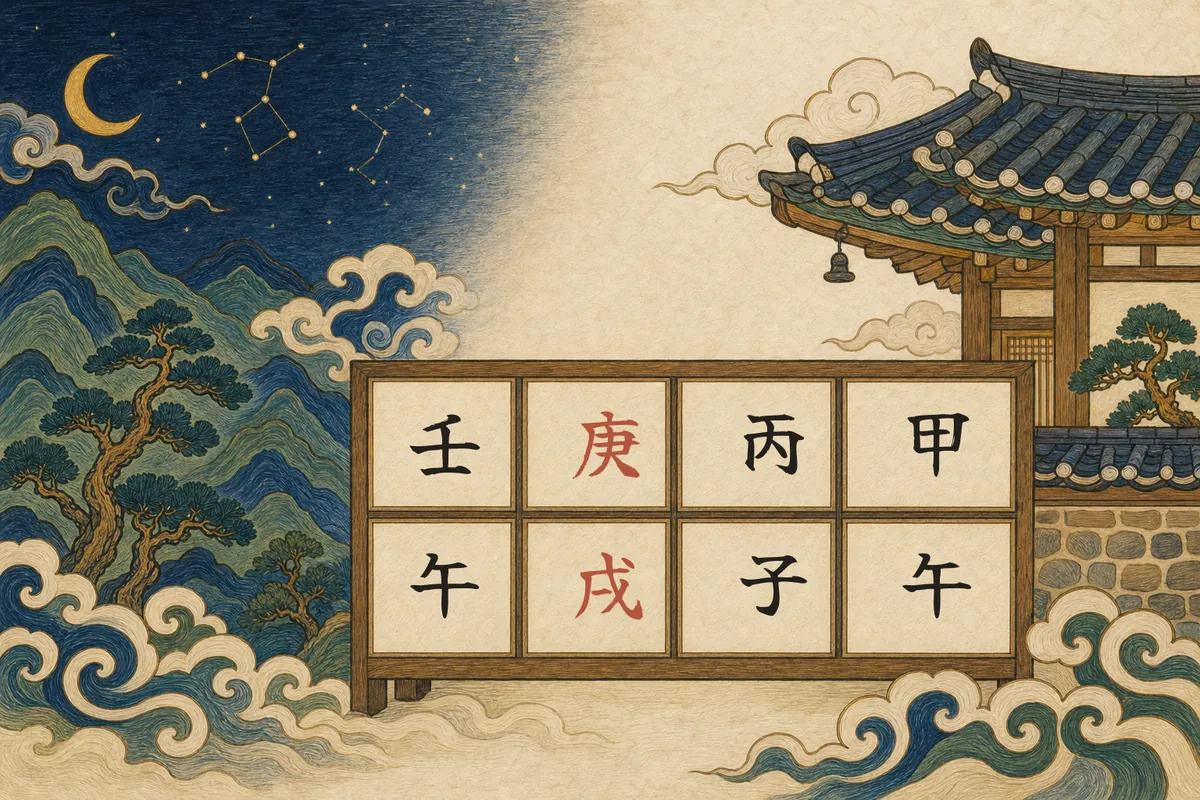
- Saju turns your birth year, month, day and hour into eight characters from an ancient calendar, then reads how their five elements balance.
Western astrology is like a photo of the sky at your birth. Saju is like the timestamp on that photo, written in a code where every part of the timestamp has a meaning.
Side by side
| Western astrology | Korean Saju | |
|---|---|---|
| Built from | Planet positions | Calendar cycles (stems and branches) |
| Core pieces | 10 planets, 12 signs, 12 houses | 8 characters: 10 stems, 12 branches |
| “Main you” | Sun sign (plus moon and rising) | Day Master |
| Building blocks | 4 elements (fire, earth, air, water) | 5 elements (Wood, Fire, Earth, Metal, Water) |
| Year starts | Sun sign changes monthly; no “year sign” | Start of Spring, around February 4 |
| Birth time gives | Rising sign and houses | Hour pillar (2 of 8 characters) |
| Timing tools | Planets’ current movements (transits) and returning cycles | 10-year luck cycles, yearly and monthly energies |
| Relationship reading | Synastry | Gunghap (compatibility) |
Your “main sign” is chosen differently
In Western astrology, the sun sign is the headline, and it changes about once a month. Everyone born in roughly the same four weeks shares it.
In Saju, the headline is your Day Master, the top character of your day pillar. It changes every day, cycling through ten possibilities. So two people born a week apart, with the same sun sign, will usually have different Day Masters. (The 10 Day Masters)
Four elements vs five
Western astrology has fire, earth, air and water. Saju has Wood, Fire, Earth, Metal and Water. There’s no “air” in Saju, and two elements Western readers don’t expect: Wood (growth, planning, beginnings) and Metal (decisions, standards, finishing).
The bigger difference is how the elements relate. In Saju, elements form a cycle:
- They feed each other: Wood feeds Fire, Fire makes Earth, Earth holds Metal, Metal carries Water, Water grows Wood.
- They keep each other in check: Wood holds Earth together, Earth contains Water, Water cools Fire, Fire shapes Metal, Metal prunes Wood.
So Saju doesn’t just ask “how much Fire do you have?” It asks “what is your Fire feeding, and what is keeping it in check?” (The 5 Elements in Saju)
Saju has no planets
This surprises people. Saju doesn’t use the planets at all. Its characters come from cycles of time: the 60-year cycle, the solar terms that mark the seasons, the 60-day cycle and the two-hour blocks of the day.
The sun does matter, in a way. Saju months begin at the solar terms, points on the sun’s yearly path, and many careful calculators, ours included, adjust your birth hour to where the sun actually was. But there’s no Mercury retrograde in Saju.
Timing: transits vs luck cycles
Western astrology tracks timing with transits, like your Saturn return around age 29.
Saju uses 10-year luck cycles (대운, daeun): a sequence of pillars that each color about a decade of your life. Each year and month also brings its own energy that meets your chart. If your chart is the house you were born with, the luck cycles are the seasons passing over it. (Luck Cycles: Your 10-Year Seasons)
Same person, two languages
Take Maya, a fictional example born September 21, 1994, at 2:20 p.m. in Austin. By Western astrology, a late-September birthday puts her sun in Virgo, close to the Libra edge.
In Saju, she’s a Yang Metal Day Master (raw ore, a strong blade) born in the autumn Metal season, with a chart where all five elements appear and that welcomes Wood and Fire for balance. Same moment, two very different vocabularies.
Neither one cancels the other. Many people enjoy both, the way you might read a book in two translations and notice different things each time.
What each does best
Many Western astrology readings lean into psychological language: inner drives, emotional needs, how you come across. (Western astrology looks closely at timing too, through transits.)
Saju readings often put extra weight on balance and timing, while still describing personality: what your chart has too much or too little of, and which seasons of life support pushing forward versus slowing down. Korean readings also tend to be very practical: work, money, relationships, when to act.
Which is “more accurate”?
Honestly, that’s not the most useful question. Both are traditional systems for reflection, not science. A better question is: which one gives you language that helps you think clearly? For many people, the answer is “both, for different things.” (Is Saju Fortune Telling?)
Questions beginners ask
Can I use both?
Yes. Many people do. They use different vocabularies, so they often notice different things.
Is there a Saju version of a rising sign?
The closest thing is your hour pillar, which also depends on your birth time. But it plays a different role: plans, the people you guide, and later life.
Does Saju use my birthplace?
Yes, to adjust your birth time to local solar time and to get the right date where you were born.
Try Saju if you love astrology
If you already have your natal chart memorized, here’s a fun first step: find your Day Master free, then compare it to your sun sign. Notice where they agree and where they surprise you.
And if you’d like your full Saju chart explained the way an astrologer might explain your natal chart, every character and timing cycle in plain English, the Korean Saju Birth Chart Reading is a good place to start.
What's your real animal?
Free, about 30 seconds, and your birthday never leaves your phone.
Find my real animal