Watched Battle of Fates? Here's What Saju Actually Is
Battle of Fates (운명전쟁49) put shamans, saju readers, tarot readers and face readers on one stage. If the show made you curious about saju, here's how it really works and how it differs from the other traditions.
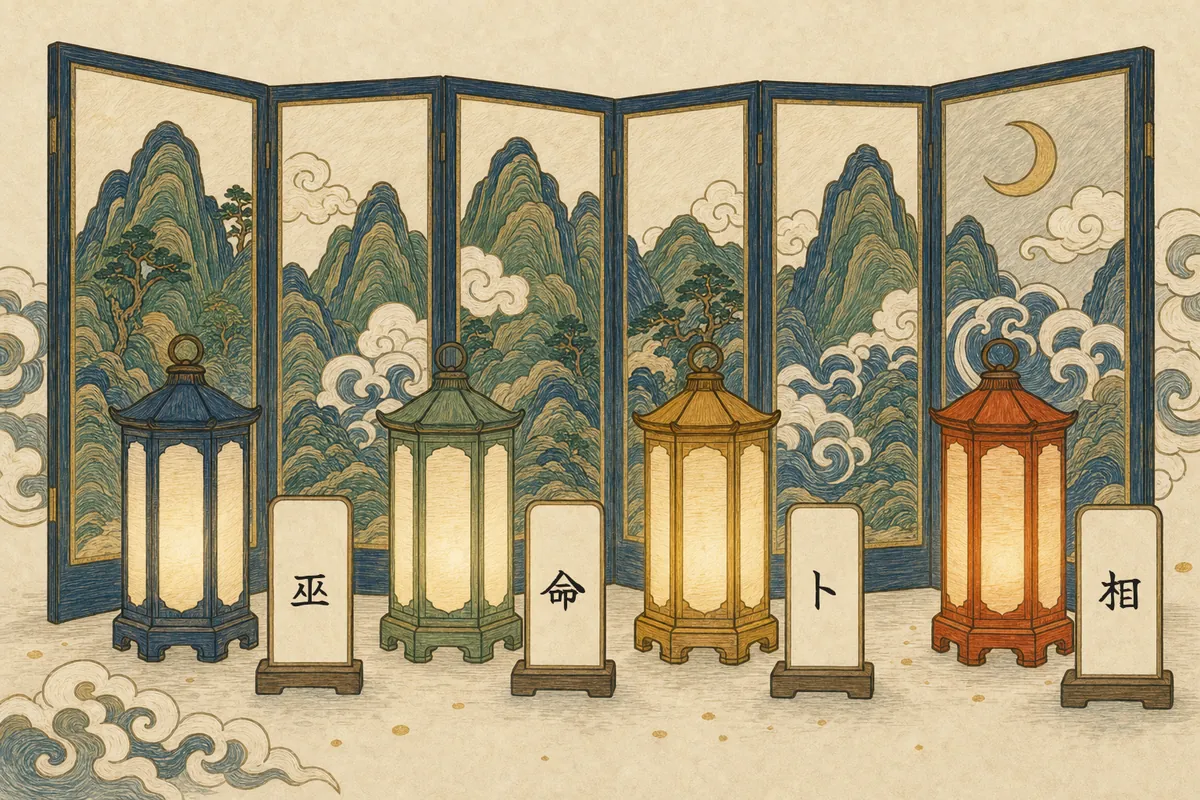
If you binged Battle of Fates and came away thinking “wait, what exactly were the saju people doing?”, you’re not alone. The show put four very different Korean fortune traditions on one stage, and on TV they can blur together.
They’re not the same thing at all. Here’s a friendly guide to the one built around your birth date and time: saju.
Quick answer: Battle of Fates (운명전쟁49) is a Korean competition series released on Disney+ in 2026, with fortune readers from several traditions competing in elimination rounds. Saju is the one that works from a calculation: it turns your birth date and time into eight characters and reads them by rules. It needs your birth details, it takes time, and at its best it describes tendencies, not fixed events.
The show, in one paragraph
Battle of Fates, called 운명전쟁49 (roughly “Fate War 49”) in Korean, was released on Disney+ in 2026 as one 10-episode season. It gathered 49 fortune readers from different traditions, including shamans, saju readers, tarot readers and face readers, and put them through elimination rounds. It’s streaming on Disney+, and in the U.S. on Hulu as well. It arrived as part of a wider wave of fortune-themed entertainment in Korea.
Four traditions, four very different methods
| Tradition | Korean | Works from | How it reads |
|---|---|---|---|
| Saju | 사주 | Your birth date and time (the place sets the exact local time) | Calculates eight characters, reads them by rules |
| Shamanism | 무속 (musok) | Spiritual practice and ritual | Through the shaman’s spiritual work |
| Tarot | 타로 | Cards drawn for a question | Interprets the cards drawn |
| Face reading | 관상 (gwansang) | Facial features | Reads traits from the face |
Saju stands apart because it’s calendar math first. Two saju readers using the same rules will write down the exact same chart for you. Where they can differ is in interpretation, the way two readers can notice different themes in the same book.
Why saju looks a little strange on TV
Television loves a fast, dramatic reveal. Saju isn’t built for that:
- It needs data. Without a birth date (and ideally a time and city), there’s no chart to read.
- It takes time. A careful reader works through the Day Master, the season, the balance of five elements, the relationships between characters, and the 10-year cycles. (How to Read Your Saju Chart, Step by Step)
- It speaks in tendencies. A good reading says “this is the kind of season you’re in,” not “this will happen on Tuesday.”
So if a show frames saju as a contest of who can predict the most dramatic fact fastest, that’s a fair test of showmanship, not really of saju. Saju works more like a long, thoughtful conversation with a chart in the middle of the table.
What saju actually reads
In plain terms:
- Your four pillars: your birth year, month, day and hour, each written as two characters. (What Are the Four Pillars?)
- Your Day Master: the one character that stands for you. (The 10 Day Masters)
- The five elements: Wood, Fire, Earth, Metal and Water, and how balanced they are. (The 5 Elements in Saju)
- Roles (the Ten Gods): how each character relates to you, which is how saju talks about work, money, love and friends.
- Timing: 10-year Luck Cycles and the energy of each year.
A tiny example
Here’s a fictional example, Maya, born September 21, 1994, at 2:20 p.m. in Austin. A saju reader wouldn’t look at her face or draw a card. They’d calculate:
| Hour | Day | Month | Year |
|---|---|---|---|
| 壬午 Water Horse | 庚戌 Metal Dog | 癸酉 Water Rooster | 甲戌 Wood Dog |
Then they’d start talking: a Yang Metal Day Master born in autumn, its own season; all five elements present; leaning slightly strong, so it welcomes Wood and Fire. That’s slower than a TV reveal, but it’s the real thing.
Where saju sits in Korean life
Saju has been part of Korean culture for centuries, from court specialists in the Joseon dynasty to today’s saju cafés and phone apps. Many Koreans check it around big moments, like a new year, a job change or a wedding, often more as a way to think than as a prophecy. (Where Saju Comes From)
Common mix-ups after watching
- “Saju readers are shamans.” Different traditions. Some people practice more than one, but saju itself is a calculation read by rules.
- “Saju can read anyone on sight.” Not without birth details. That’s face reading’s territory.
- “A good reader predicts exact events.” A careful saju reading avoids that and talks in tendencies and timing. (Is Saju Fortune Telling?)
Questions beginners ask
Is Battle of Fates on Netflix?
No. It’s a Disney+ original, also available on Hulu in the U.S.
Is saju the same as Chinese BaZi?
Same roots and the same calculation. “Saju” is the Korean name and Korean style of reading it.
Can I try saju without a reader?
Yes. You can calculate your chart free and start with your Day Master. A full reading adds the interpretation.
Try the real thing
The show is a fun doorway. If you’d like to see what saju says about you, start with your free chart. And if you want your eight characters read the patient way, every term explained in plain English, the Korean Saju Birth Chart Reading is made from your exact birth date, time and city.
What's your real animal?
Free, about 30 seconds, and your birthday never leaves your phone.
Find my real animal